
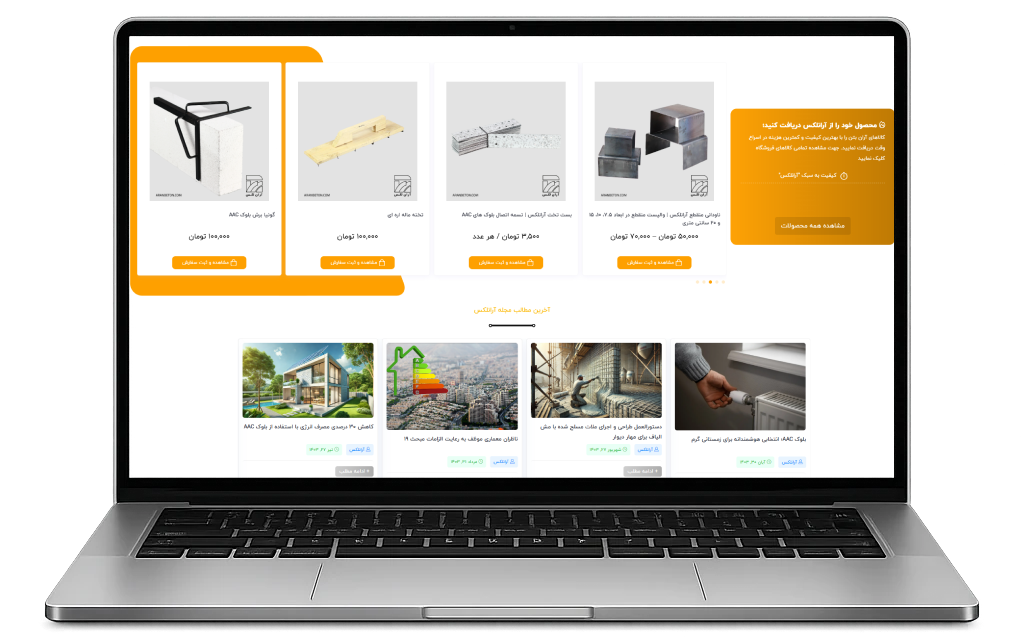
Overview:
Polymer Beton Aran Company is the first manufacturer of autoclaved aerated concrete (AAC) blocks in the northwest of Iran. With a commitment to innovation, quality, and sustainability, the company launched its first AAC lightweight wall block production line under the proprietary and commercial brand ARANLEX in late 2011. By combining advanced technology with engineering expertise, Polymer Beton Aran aims to provide modern, efficient, and eco‑friendly construction solutions that meet international standards and the evolving needs of the construction industry.
The company’s product range includes a complete set of installation and structural accessories designed specifically for AAC systems, including:
- Steel Angles (for structural reinforcement and stable connections)
- ARANLEX Radical Clamp
- ARANLEX Flat Clamp
- AAC Block Connecting Strap
- AAC Block Adhesive
Project Challenges
Every software project, beyond coding itself, involves a set of technical and business challenges whose proper management has a direct impact on the final success of the product.
Detailed Requirements Analysis
Translating the initial business needs into clear and implementable technical documentation required continuous interaction with stakeholders, receiving periodic feedback, and aligning business goals with technical solutions.
Choosing the Optimal Architecture
Designing a scalable, secure, and high‑performance architecture that allows for easy future development and maintenance was one of the key and most influential decisions in the project.
Integration with Existing Systems
Connecting and synchronizing the project with existing services, APIs, and infrastructures—without causing disruption in the active systems—required precise design and multi‑stage testing.
Performance and User Experience Optimization
Achieving balance between speed, system stability, and a smooth user experience— especially under heavy loads and simultaneous users—was one of the major challenges of this project.
Change Management and Scalability
Changing requirements and priorities during the development cycle is inevitable. Designing a flexible structure capable of managing these changes—without quality decline, cost increase, or technical risk—was one of the essential requirements of the project.